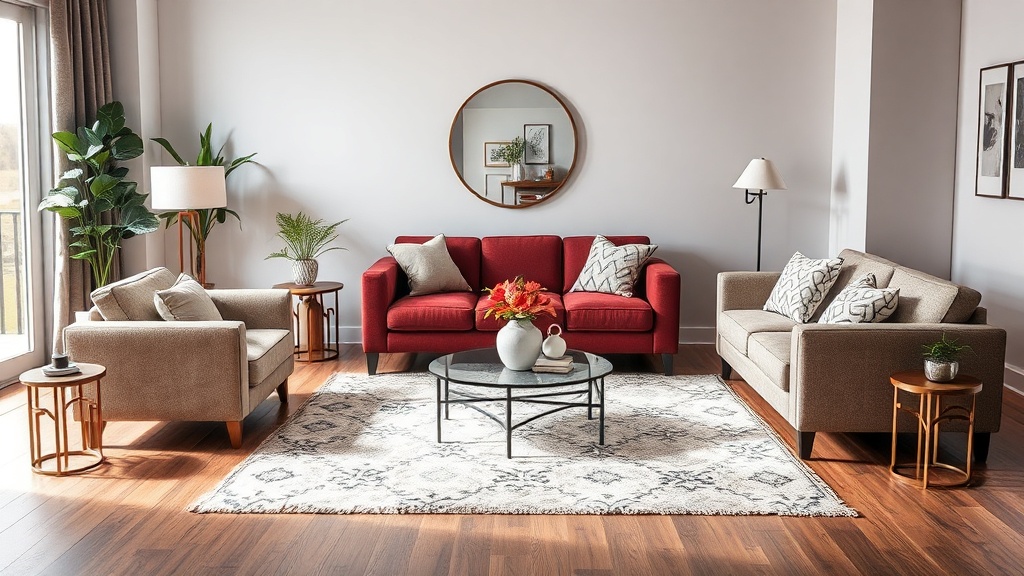
Why Your Living Room Furniture Layout Feels Off

The Hidden Math of Living Room Layouts
Research suggests the average person spends over two years of their life sitting in their living room, yet most people set up their furniture based on instinct rather than spatial logic. When a room feels "wrong," it rarely stems from poor furniture choices; it usually comes down to the invisible lines of circulation and scale. A poorly placed coffee table or a sofa that sits too far from the television creates a visual disconnect that makes even the most expensive pieces look awkward. This post examines how to fix those spatial gaps through better positioning and scale management.
The most common mistake I see in interior design isn't a lack of style—it's a lack of breathing room. People often push every piece of furniture against the walls, creating a "waiting room" effect. This actually makes a room feel smaller and more rigid. Instead, try pulling furniture away from the perimeter to create paths for movement. This creates a sense of depth that makes a room feel intentional rather than cramped.
Does furniture size matter for small rooms?
It absolutely does. One of the biggest errors in home design is choosing pieces that are either too massive for the space or too tiny to feel grounded. If you have a small living room, a massive overstuffed sectional will swallow the room, leaving no room for your eyes to rest. Conversely, a tiny loveseat in a massive room looks lonely and unfinished.
When shopping, look at the footprint of the piece. You want to maintain a clear path of at least 18 inches between your coffee table and your seating. This is the gold standard for comfort. If your furniture layout forces you to squeeze past a table or shimmy past a chair, the layout has failed. You can find excellent guides on furniture dimensions and spatial requirements at Architectural Digest to ensure your pieces actually fit the scale of your architecture.
The Coffee Table Disconnect
The coffee table is the anchor of the living room, but it's often the most neglected piece in terms of proportion. A common issue is a coffee table that is too low or too far away. If it's too low, it feels like a pit in the center of the room; if it's too far, it becomes a barrier rather than a utility. Aim for a height that is roughly one to two inches lower than your sofa cushions. This keeps the sightlines open and prevents the room from feeling broken up.
Consider the shape of your seating when picking a table. If you have a large, rectangular sectional, a round coffee table can break up the harsh lines and make the room feel more fluid. If your seating is curved, a rectangular or square table provides the necessary structure. It's about balance, not just matching sets.
How do I organize a living room for better flow?
Flow is the movement of people through a space. In a living room, this usually means the path between the entrance, the seating area, and the exit. If your furniture creates a zigzag pattern that people have to navigate, the room will always feel chaotic. To fix this, map out the natural walking paths in your room. If a chair is blocking a doorway or a side table is in the way of a person walking to a window, move it.
A good rule of thumb is the "perimeter path." You should have a clear, unobstructed path around the central seating area. If you find yourself constantly walking around a large ottoman to get to the kitchen, your layout needs a redesign. You can also use area rugs to define these zones. A rug acts as a visual boundary—it tells the brain, "This is the seating zone, and that is the walking zone."
- Zone 1: The Conversation Circle: Keep seating within a distance where people don't have to shout to be heard.
- Zone 2: The Traffic Lane: Ensure there is at least 3 feet of space for major walkways.
- Zone 3: The Visual Anchor: Use a rug to tie the furniture together so pieces don't feel like they're floating.
Don't forget about lighting. Lighting is the final layer of any layout. If you only have one overhead light, your room will have harsh shadows that make the layout feel disjointed. Incorporate floor lamps and table lamps at different heights to create layers of light. This adds depth and makes the furniture placement feel more organic and less like a showroom floor.
For more technical advice on interior proportions and lighting, Remodelista offers excellent insights into how to layer different elements within a room. Remember, a good layout isn't about following a trend; it's about how the space feels when you actually live in it. If you can move through your room without thinking about your feet, you've succeeded.