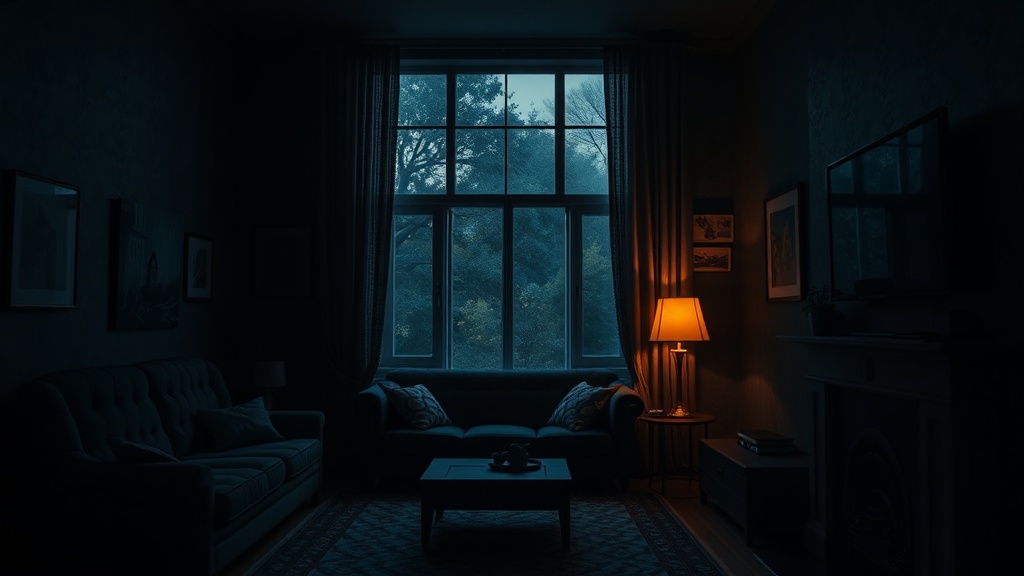
Why Your Dark Apartment Feels Smaller Than It Actually Is

Research from the Lighting Research Center (https://www.lrc.rpi.edu/) indicates that the way light hits your walls can change your perception of space by nearly 20 percent. It isn't just about brightness; it's about where that brightness lives. If your corners are dark, your brain tells you the room ends where the shadows begin. This isn't a problem you can solve by just buying a brighter bulb and sticking it in the center of the ceiling (in fact, that usually makes things worse). We're going to look at the geometry of light, why your current setup is shrinking your home, and how you can fix it without a single power tool.
Shadows are the silent killers of a minimal aesthetic. In a home that values the "less is more" philosophy, every square inch of visible floor and wall is important. When light is uneven, you create visual clutter without having a single object on the floor. High-contrast zones—areas where it's very bright right next to deep darkness—make the eye work harder. This visual noise makes a room feel cramped and restless, regardless of how much you've decluttered your shelves.
Does lighting actually change the physical size of a room?
Your eyes don't see rooms; they see light bouncing off surfaces. When light hits a wall, it defines the boundary. If that wall is in shadow, the boundary is fuzzy. By lighting the perimeter of a room—a technique called "wall washing"—you draw the eye to the furthest points of the space. This tricks your brain into thinking the walls are further away than they are. When you illuminate the very edges of your floor plan, you reclaim the square footage that shadows were previously hiding.
It's also about verticality. Low-slung lamps that only point downward keep the ceiling in the dark. This "lowers" the ceiling visually. If you've ever felt like your apartment was pressing down on you, check your lamps. You want light to hit the ceiling and reflect back down. This "uplighting" creates a sense of height that makes even a standard eight-foot ceiling feel much higher. It's a simple trick of physics that doesn't require any construction or expensive renovations.
Where should you place lamps to maximize space?
The "three-point lighting" rule is your best friend here. Don't rely on one big light. Instead, you want to spread the light across three distinct levels. The first level is your "ambient" light—the general glow of the room. The second is "task" lighting—focused beams for reading or cooking. The third is "accent" lighting—small lights that highlight depth. Harvard Health (https://www.health.harvard.edu/staying-healthy/blue-light-has-a-dark-side) notes that light impacts our mood and alertness, but in design, these layers prevent the "flat" look that makes small rooms feel like boxes.
Put a tall floor lamp in the corner furthest from the door. This ensures that as soon as you walk in, your eye is drawn to the full depth of the room. Use table lamps on surfaces like sideboards or desks to fill in the mid-level gaps. Avoid opaque lampshades that only let light out the top and bottom. Instead, choose linen or thin paper shades that glow themselves. This turns the lamp into a source of soft, diffused light rather than a spotlight. When the lamp itself glows, it adds to the total volume of light in the room without creating harsh glare.
How can you fix a room with no windows?
Windowless rooms feel small because they lack the "cool" light of the sky. Most people try to compensate by using very warm, yellow bulbs, thinking it makes the room "cozy." In reality, yellow light in a basement often feels dingy and stagnant. You need to mimic the color temperature of daylight. This is where the Kelvin scale comes in. Bulbs around 5000K provide that crisp, blue-white light that our brains associate with the outdoors.
According to Energy.gov (https://www.energy.gov/energysaver/led-lighting), LED bulbs are now capable of hitting these specific color temperatures with high efficiency. If you place a 5000K bulb in a floor lamp and point it at a white ceiling, the reflected light will feel much more like natural sun. It's also worth using mirrors to "bounce" this light. Don't just hang a mirror for the sake of it; place it where it will catch the light from your lamps. This effectively doubles the light sources in the room without adding more clutter to your walls.
Understanding the Kelvin Scale
Most people buy "soft white" bulbs (2700K) because that's what we've used for decades. But "soft white" is actually quite orange. In a minimal home with white or grey walls, this orange light can make everything look muddy. If you want your space to feel sharp and open, look for "Cool White" or "Bright White" bulbs (3500K to 4100K). These provide a neutral light that keeps colors accurate and spaces feeling fresh.
| Light Type | Kelvin Range | Best Used For |
|---|---|---|
| Warm White | 2700K - 3000K | Bedrooms and "cozy" nooks |
| Neutral White | 3500K - 4100K | Living rooms and kitchens |
| Daylight | 5000K - 6500K | Home offices and dark basements |
The Impact of CRI on Spatial Quality
CRI stands for Color Rendering Index. It measures how accurately a light source reveals the true colors of objects. Most cheap LEDs have a CRI of around 80. This is okay, but it can make your interior design look a bit "off" or flat. If you find bulbs with a CRI of 90 or higher, you'll notice a massive difference. The textures of your fabrics, the grain of your wood furniture, and the subtle tones of your paint will pop. This depth prevents the room from feeling like a two-dimensional box.
It's the difference between a room that looks "okay" and one that looks like it belongs in a magazine. High CRI lighting adds a layer of richness that makes a minimal space feel intentional rather than empty. When colors are vibrant and clear, the space feels more alive, which naturally makes it feel larger. It's an important detail that many homeowners overlook when trying to simplify their homes.
Managing Visual Weight and Clutter
In minimal design, we talk a lot about the "visual weight" of furniture. A dark mahogany desk feels heavier than a light oak one. Lighting works the same way. A dark corner has a heavy visual weight—it pulls the room inward. By illuminating that corner, you lighten its weight and let the room "breathe." This is why a well-lit corner can feel more open than an empty one that sits in shadow.
Think about the "negative space" in your home. These are the empty areas between your furniture. If these areas are in shadow, they disappear. If they are lit, they act as a buffer that keeps the room from feeling crowded. You don't need a lamp for every square foot, but you do need to make sure your light is reaching the floor. Pendent lights that hang too low often leave the floor in darkness, which "cuts off" the bottom of the room. Make sure your light sources are balanced so that the floor, walls, and ceiling all get a share of the lumens. Take a look at your living room tonight when the sun goes down. If you see shadows pooling in the corners or under the sofa, you're losing space. Your apartment isn't small; it's just poorly lit.