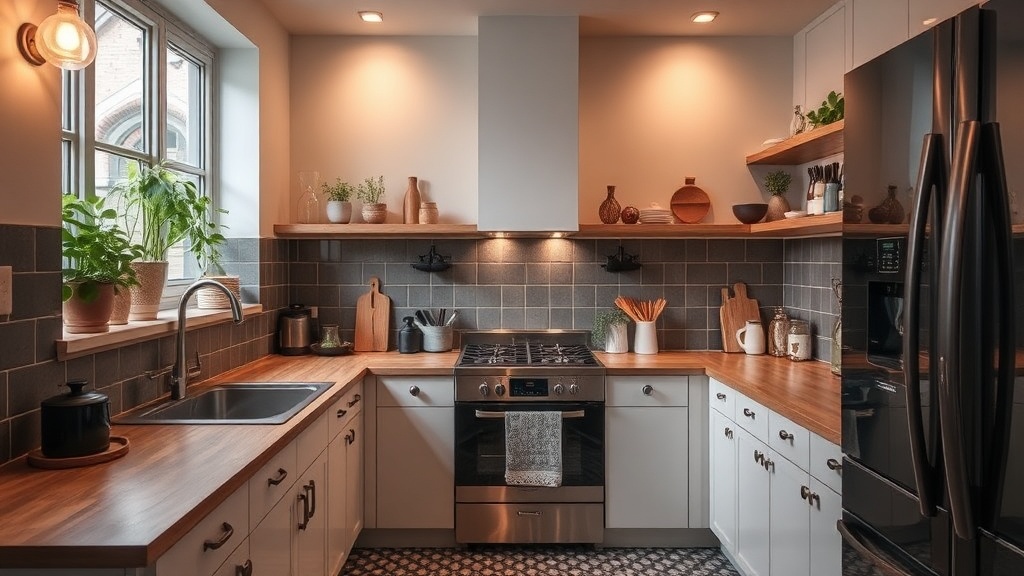
Ingenious Ways to Make Your Compact Kitchen Feel Expansive and Work Harder

Ingenious Ways to Make Your Compact Kitchen Feel Expansive and Work Harder
Facing a kitchen where every inch feels fought over? A small kitchen doesn't mean sacrificing functionality or style. This guide focuses on practical, often overlooked strategies to transform cramped cooking spaces into efficient, enjoyable hubs. We'll explore clever storage solutions, layout tweaks, and visual tricks that make a significant impact, ensuring your compact kitchen serves your needs without feeling overwhelming.
How can I optimize my kitchen layout for better flow?
Even the smallest kitchen benefits immensely from thoughtful layout planning. The traditional ‘work triangle’ concept, though sometimes adapted for compact spaces, remains a powerful guide for efficiency. This principle suggests that your refrigerator, sink, and primary cooking surface (stove/oven) should form a natural triangle, minimizing the steps between these key zones.
For truly tiny kitchens, particularly galley or one-wall layouts, a modified approach emphasizing a 'work line' can be just as effective. Here, you're looking to create a logical sequence of tasks: food prep, cooking, and cleaning, with each appliance or workspace positioned optimally. Think about your movements during meal preparation—where do you take food from the fridge? Where do you wash it? Where do you chop? Where does it go onto the pan? Ensuring smooth transitions between these actions reduces frustration and makes the space feel more intuitive.
“A well-designed kitchen, regardless of size, prioritizes clear pathways and logical workflow. Consider the National Kitchen & Bath Association’s (NKBA) guidelines for minimum clearances, which recommend at least 42 inches for a single-cook work aisle and 48 inches for multiple cooks. While these ideal measurements might be challenging in smaller footprints, striving to maximize your available circulation space is key to preventing bottlenecks.”
Crucially, ensure adequate landing space adjacent to your appliances. A refrigerator needs a nearby counter for unloading groceries, the stove requires a safe spot for hot pans, and the sink benefits from clear areas for dirty dishes and drying. Even a small pull-out cutting board or a narrow counter extension can drastically improve functionality here. These small considerations keep your workflow smooth and safe, making the most of every surface.
What are the smartest storage solutions for tiny kitchens?
When floor space is limited, the only way to go is up—or inward. Vertical storage is your greatest ally in a small kitchen. Utilize every possible height, from the back of cabinet doors to the often-neglected space above your upper cabinets. Open shelving can be a boon, especially for frequently used items or attractive dishware, but be mindful not to overcrowd it, as this can quickly lead to a cluttered look. Closed cabinetry, however, remains king for containing visual chaos.
Inside your cabinets and drawers, organization systems are a necessity, not a luxury. Think about stackable organizers for plates, tiered shelving for spices, and drawer dividers for utensils. Deep drawers can be transformed with pull-out inserts for pots and pans, while corner cabinets, often awkward and underutilized, can house lazy Susans or specialized pull-out mechanisms that bring items within easy reach. Don't forget about the backs of cabinet doors—they're perfect for hanging measuring spoons, pot lids, or even a small magnetic knife strip.
Wall-mounted solutions also offer significant gains without encroaching on precious counter space. Magnetic knife racks free up drawer space, while pegboards can organize an array of cooking tools, often becoming a stylish feature in themselves. Rail systems with hooks allow you to hang frequently used utensils, small pots, or even fresh herbs, keeping them accessible and adding a touch of personality. For those with a bare wall, a narrow, floor-to-ceiling pantry unit (even just 8-12 inches deep) can provide an incredible amount of storage for non-perishables.
Finally, consider multi-functional furniture. A kitchen island on wheels can serve as extra prep space, a dining area, and even a storage unit with built-in shelves or drawers. Nesting tables or stools that tuck away neatly can provide flexible seating when needed without permanently occupying valuable floor area. Every piece of furniture in a small kitchen should earn its keep, ideally serving more than one purpose.
How can I make a small kitchen appear larger and brighter?
Beyond clever organization, strategic design choices can trick the eye, making your compact kitchen feel significantly more spacious and airy. The most impactful changes often involve color, lighting, and reflective surfaces.
Light color palettes are paramount for creating an illusion of space. White, pale grays, and soft pastels reflect light, preventing walls from feeling like they’re closing in. This applies not just to walls, but also to cabinetry and countertops. If you crave a touch of color, introduce it through accessories or a single accent wall, but keep the overall scheme bright and cohesive. Darker colors absorb light and can make a room feel smaller and heavier, so use them sparingly, perhaps only on lower cabinets or as a grounding element.
Lighting is another powerful tool. Layered lighting is ideal: combine ambient light (overhead fixtures) with task lighting (under-cabinet lights, pendant lights over a small island) and accent lighting (spotlights on artwork or shelving). Under-cabinet lighting is particularly effective in small kitchens as it brightens work surfaces and eliminates shadows, making the entire space feel more open and functional. Natural light, where available, should be maximized—avoid heavy drapes or blinds that block windows. If natural light is scarce, consider adding mirrors strategically to reflect light and create the perception of a larger room. For more information on effective kitchen design, including lighting principles, explore resources like